DMR Repeater Solution
A DMR repeater built on the SCT3252BT full duplex baseband processor, with the SCT9377 repeater baseband board.
Solution material and datasheets are not published for download. This opens an email with the solution named; sales will get back to you.sales@sicommtech.com
SCT3252BT is a low power, high performance processor built specifically for DMR repeaters (base stations), compliant with ETSI TS 102 361. It works in full duplex: it takes the FM-demodulated uplink from the receiver, performs 4FSK demodulation and error correction, extracts signalling and voice or data payload per the DMR protocol, then reformats and modulates the downlink.
It carries no vocoder — add an SCT3258TD when voice monitoring or insertion is needed. It supports FEC decoding and re-encoding for AMBE+2™, and passes encrypted voice streams through unaltered. The repeater also works in analogue: uplink and downlink can use different CTCSS / DCS, and analogue or DMR signals are detected automatically on receive.
To start at board level, the SCT9377 repeater baseband board already carries the SCT3252BT and SCT3258TD; with the customer's own RF section it makes a DMR or analogue repeater. See below.
Highlights
- All DMR Tier 2 repeater functions, including preservation frames that hold the channel
- Full duplex 4FSK modem at 9600 bps
- AMBE+2™ FEC decoding and re-encoding; 16 / 64 / 192-bit encrypted voice passes through
- Analogue repeating: CTCSS / DCS detection and regeneration, automatic analogue / DMR detection
- SCT9377 repeater baseband board carrying SCT3252BT and SCT3258TD
Parts in this solution
| SCT3252BT | Repeater baseband processorFull duplex; the current part in the SCT3252 family |
|---|---|
| SCT9377 | Repeater baseband boardCarries SCT3252BT and SCT3258TD |
| SCT3258TD | Vocoder (optional)For voice monitoring or insertion |
Repeater Baseband Board
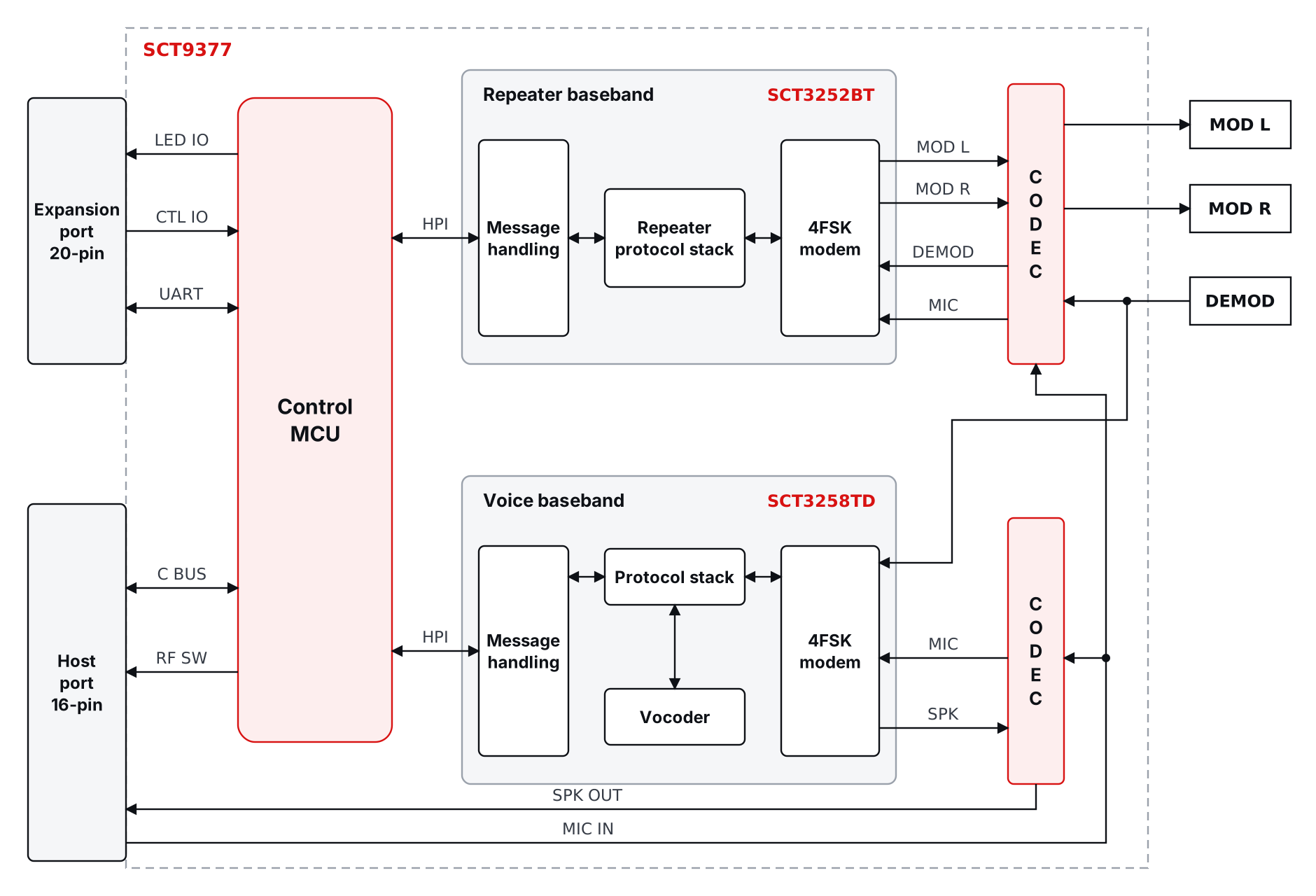
SCT9377 is SICOMM's repeater baseband board. It combines a control MCU, a repeater baseband (SCT3252BT) and a voice baseband (SCT3258TD), complies with ETSI TS 102 361 (DMR), and integrates the 4FSK modem, channel codec and repeater protocol processor the standard requires.
It works with the RF channels of an existing analogue repeater: with the customer's own RF section, it gets DMR repeaters, analogue repeaters and dispatch stations to market quickly, and it can monitor relayed voice and originate voice calls.
The board offers UART and SPI. UART lets PC software configure parameters and run performance tests; an external host can use SPI or UART to control transmit and receive and switch modes, and to read back status and parameters, which leaves room to build advanced features on top.
Features
- Repeater protocol processor compliant with DMR Tier I / II
- 4FSK modem and channel codec at 9.6 kbps
- Built-in AMBE+2™ vocoder for voice monitoring and originating calls
- Monitoring and originating data communication
- Dual-frequency repeater mode
- Configurable idle channel hang time and call hang time
- FM repeating: modulation and demodulation, companding, pre- and de-emphasis, analogue and digital sub-audio signalling
- RF interface takes the baseband demodulated signal and drives two-point or single-point modulation
- Selective address filtering
- Configured from companion PC software
Typical applications
- Public digital radio repeaters (single site)
- Analogue repeaters
- Dispatch stations
- Wide-area base stations for security, ports and warehousing
Internal block diagram